

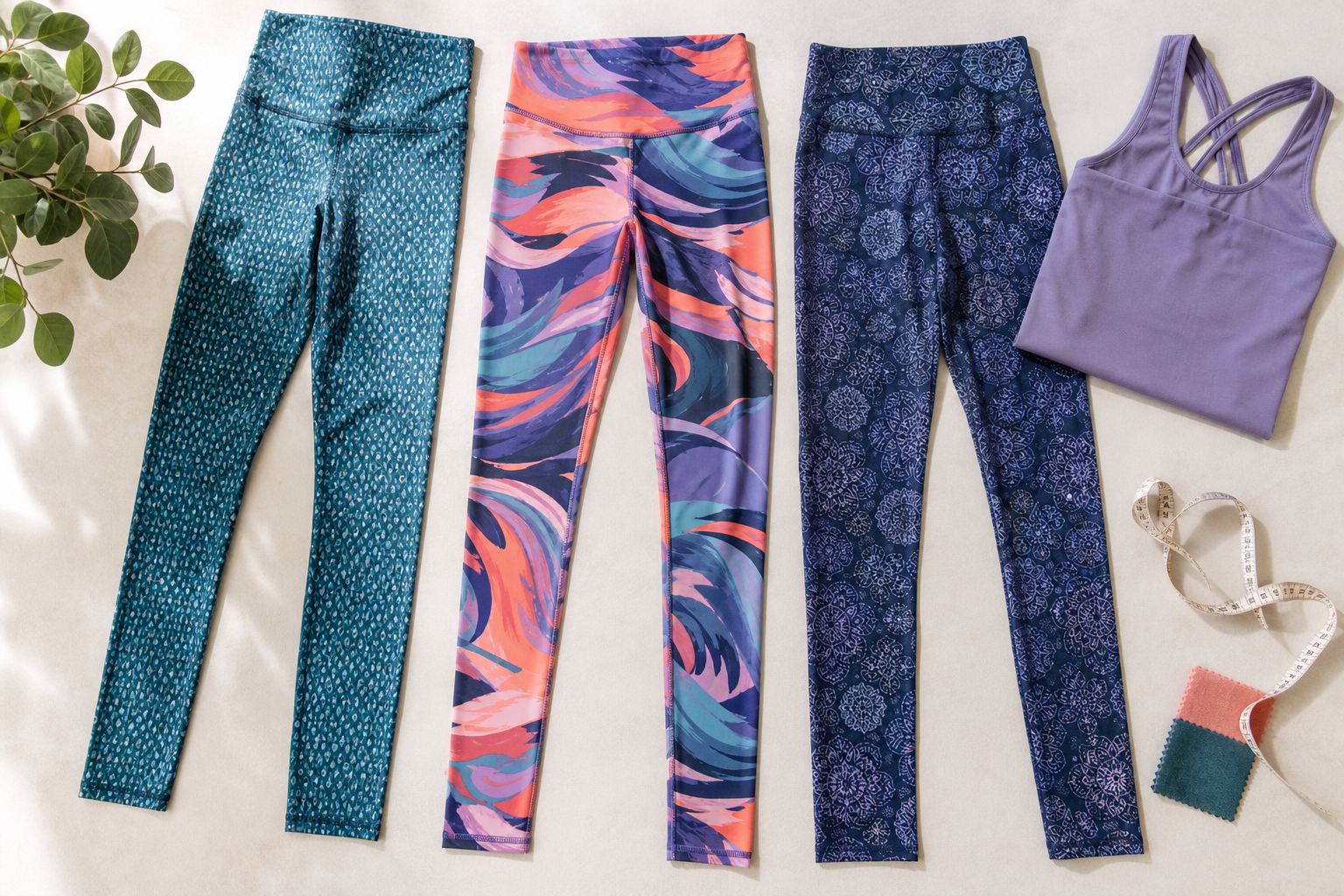
The short answer: choose printed leggings by checking the current size chart against your waist, hip and inseam measurements; deciding where you want the waistband to sit; testing fit and opacity in several ordinary movements; previewing where the print falls at seams and stretch points; and matching the garment to its stated use and care label. A vivid print can be the first thing you notice, but fit, coverage and maintenance determine whether the pair works in your wardrobe.
Printed leggings are not standardized across brands or styles. In Canada, the Competition Bureau notes that garment makers are not required to use one universal set of size dimensions or codes, although any stated dimension must be accurate. That makes the live product chart and measurements more useful than assuming your usual letter size will fit every pair.
Printed leggings checklist at a glance
| Decision | What to check | Why it matters |
|---|---|---|
| Size | Current waist, hip and inseam guidance | A familiar size name can represent different measurements |
| Waist and rise | Where the band sits, rolls or gaps | Rise changes how the waist and pattern feel in motion |
| Length | Inseam and desired ankle finish | Extra length may bunch; too little changes the intended look |
| Opacity | Coverage in bright light while bending and sitting | Stretch can change how colour and coverage appear |
| Pattern | Scale, seam alignment and placement | Large and small motifs create different visual effects |
| Use | Product description and real activity | Casual leggings are not automatically sport, work or safety gear |
| Care | Fibre disclosure and garment care label | Specific materials and finishes may require different treatment |
1. Measure before choosing a size
Use a soft tape and the measurement method shown on the current product page. As a general starting point, measure your natural waist without pulling the tape tight, the fullest part of your hips with the tape level, and the inside leg from the crotch area to the point where you want the hem to finish. Measure over lightweight clothing or close to the body, depending on the chart's instructions.
Compare all relevant measurements rather than selecting from waist alone. If your measurements cross two listed sizes, consider which area most affects your comfort and read the current product details and return terms before ordering. Do not assume that sizing up always solves opacity or that sizing down always creates support; either choice can introduce pulling, slipping or distorted print.
The High Waisted Colorful Patterns Print Leggings are a useful catalog starting point if waistband placement is central to your choice. “High waisted” describes a style direction, not a guaranteed landing point on every torso, so compare the listed rise or visual proportions with your own body.
2. Check waist, rise and inseam as a system
A waistband should sit where intended without sharp digging, repeated rolling or a large gap. Walk, sit and bend during an indoor try-on. If you have to keep pulling the band up, the size, rise, fabric recovery or cut may not suit you. If seams feel strained or the print turns visibly pale at rest, the garment may be under excessive tension.
Rise is the distance from the crotch seam toward the waistband. A higher rise can cover more of the torso, while a lower rise sits closer to the hips; neither is universally better. Torso length, hip shape and personal preference change the result. Inseam determines where the leg ends, but stretch and ankle opening can also affect bunching.
Test the ankle and knee areas as well as the waist. The hem should not cut sharply into the ankle, and the knee should bend without a tight horizontal pull line. These observations are fit checks, not proof of compression, circulation benefits, posture change or athletic performance.
3. Perform a practical opacity check
Opacity is not a permanent yes-or-no property. It can change with garment colour, fibre blend, knit density, print, size, lighting and how far the fabric stretches. Before removing tags, check the store's return conditions, then use bright indirect daylight or a well-lit room and a contrasting underlayer.
- Stand normally and inspect the front, side and back with a mirror or trusted helper.
- Sit in a chair, bend forward and perform a comfortable shallow squat.
- Look for colour fading, visible underlayers and stressed seams at the hips, knees and seat.
- Repeat with the type and colour of undergarment you plan to wear.
- If coverage changes beyond your comfort level, try a different size, print density or intended-use garment.
This is a household fit test, not a laboratory rating. A darker pattern such as the Black and Blue Mandala Print Leggings may look visually different under stretch than a lighter or more open design, but colour alone cannot guarantee opacity.
4. Choose a pattern scale you will enjoy wearing
Small repeating motifs can read as a more continuous texture from a distance, while large motifs create stronger focal points. Compare the fine repeat of the Pink Pattern Colorful Print Leggings with the larger celestial design of the Star Space Galaxy Colorful Print Leggings. Neither scale is more flattering for everyone; choose the visual balance you like with your tops and footwear.
Product photography shows one garment or sample. On a finished pair, motifs may meet at side, inner-leg or crotch seams, and exact placement can vary if the fabric is cut from a continuous printed field. Stretch can also widen shapes over the hips and knees. If the precise location or symmetry of a motif matters, review all available product images and ask the store before ordering rather than assuming every pair will be identical.
5. Match the leggings to the intended activity
Start with the live product description. Leggings presented as casual fashion should not be treated as a substitute for purpose-specific running, cycling, protective, medical or workplace garments. Terms such as “fitness” in a product name or styling image do not by themselves establish tested sweat management, abrasion resistance, compression, UV protection or squat-proof coverage.
For errands, travel or everyday outfits, prioritize a secure waistband, comfortable seams and a print that works with repeat wear. For a studio class or workout, verify that the product description supports that use, then check freedom of movement and coverage during the actual motion. For outdoor activities, assess weather, visibility, pockets, surface contact and any equipment-specific requirements separately.
A playful option such as the Watermelon Printed Leggings can anchor a casual summer outfit, but the print does not change the need to follow the garment's stated construction and care information.
6. Read fibre information and care labels
Fibre content helps you compare garments, but it does not predict every aspect of feel or durability. Fabric construction, yarn, finish and percentage blend all matter. The Competition Bureau's Canadian textile guidance explains that labels identify fibre content and dealer information; it also warns that quality and performance claims must be factual. Check the actual label rather than assuming all printed leggings use the same blend.
For cleaning, the safest default is simple: follow the care label on that exact pair. The U.S. Federal Trade Commission's Care Labeling Rule requires covered apparel instructions to state regular care, including the applicable washing or dry-cleaning method and warnings where needed. A generic internet tip should never override a more specific garment label.
- Fasten or separate anything that could snag the surface.
- Turn the leggings inside out if the label permits and if doing so protects the print from rubbing.
- Use only the wash method, temperature, bleach guidance and drying method stated on the label.
- Avoid adding high heat or ironing unless the instructions allow it.
- Store the pair clean and fully dry, away from sharp hooks or rough fasteners.
Frequently asked questions
Should printed leggings look lighter when stretched?
Some prints and base fabrics appear lighter under tension because the surface opens or the design spreads. A slight visual change is not automatically a defect, but pronounced fading can signal that the size or construction does not provide the coverage you want.
Does a darker print guarantee squat-proof leggings?
No. Dark colour can affect what the eye notices, but opacity depends on knit density, fibre, sizing, stretch and lighting. Perform a careful movement check before deciding.
Should I size up if I am between sizes?
There is no universal rule. Compare waist, hip and inseam guidance, consider the intended fit and consult the current product information. Sizing up may reduce tension but can also cause slipping or bunching.
How can I keep a print from fading?
Follow the care label exactly and avoid unapproved heat, bleach or ironing. Turn the garment inside out only when compatible with its instructions. All textiles change with wear and cleaning, so no care method can promise permanent colour.
Can fashion leggings be used for every workout?
No. Confirm the stated intended use and evaluate coverage and movement for the specific activity. Choose purpose-designed equipment when an activity requires protection, technical construction or tested performance.
Bottom line
The best printed leggings for you are the pair whose current measurements match your body, whose rise and inseam stay comfortable during ordinary movement, whose opacity meets your preference in real lighting, and whose pattern placement and care routine fit your wardrobe. Start with Comfy Essential Pants's live product details, verify fit indoors while return options remain open, and treat style names as descriptions rather than guarantees.